 |
|
Vetting test Help. |
V
otherwise #
(back to list)
* including the exhibition grade value.
(back to results)
|
||||
|
|
||||
 General.
 |
||||
|
For an object to pass the test, its 'perfection grade' shall be
higher than 90%. Hence the amount of acceptable imperfections shall
not be more than 9 percentage points, also called
imperfection or penalty points. Acceptable imperfections are often due to normal wear and tear, unintentional damage or misuse. For perfection grades to be higher than 90% is a rather demanding standard. The 'vetnorm working party' would like to stress that objects with perfection grades less than 90% could still be of great interest, especially when restorations, if any, are carefully executed. Disclaimer: These vetting test pages aims to facilitate objective and consistent vetting procedures and criteria. However, click here to view the terms of use. It is stressed that establishing an object's imperfection is the sole responsibility of the test observers*, it shall be done with great care and shall be endorsed by qualified experts. In case of a possible dispute, it is suggested to appoint an arbiter expert beforehand. * appointed by the party (parties) involved.
|
||||
|
|
||||
|
About vetting criteria
level
|
||||
|
The criteria database, as applied to perform a vetting test,
is maintained by a working party of art historians and horological experts
of which several have a long standing experience as vetting committee
members at prestigious Art & Antiques fairs. To some extent, the database
could be considered as a summary of accumulated vetting decissions. Due to
ongoing re-evaluation, the current criteria are not necessarily the same as those used in the past. The
working party will gladly consider any serious contributions from users and
fellow experts.
The criteria are to be considered as guidelines only, and do not have any official or legal status. However, parties could mutually agree to apply a vetting test as part of a deal. The weighting of an imperfection is subject to two variables, i.e. Level and Category. Hence the vetting results for two different objects, having similar imperfections, may vary substantially due to different level and or category allocation.
Important notice: |
||||
|
|
||||
|
Level (exhibition
grade) |
||||
|
Level has to do with the purpose of a vetting test and weighs the status (degree of
acceptability) of an object category when applied to a certain level. Two levels are currently selectable: - Exhibition grade II or Certification. (strict) - Exhibition grade I. (strict, some categories banned) If, for instance, the vetting-test applies to a 'local Antiques show' (grade II) the vetting will be less strict (more lenient) than when it applies to a prestigious International 'Fine Art & Antiques Fair' (grade I). Level correction points The degree of 'acceptability' is expressed by 'level' correction points, (exhibition grade points). These points are to be added to the total of the imperfection penalty points. * Very early or rare objects (gothic, renaissance) could be treated with more leniency. (negative grade points are to reduce the total of the penalty points) * A late 19th century 'Comtoise clock' may not qualify for exhibition at a prestigious International 'Fine Art & Antiques Fair'. (positive grade points or, if to be banned, an # ) |
||||
|
|
||||
|
Category
category |
||||
|
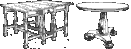
Weighing similar imperfections may vary with the object-category to
which it applies. For instance:
|
||||
|
|
||||
|
||||
|
||
|
|
||
|
By using our information and
services, you are indicating your agreement with the following terms and
conditions.
All information and services are
provided "as is". There is no warranty of merchantability, no warranty
of fitness for a particular use, and no other warranty of any kind,
express or implied, regarding the information or any aspect of the
services (including, but not limited to, information access). You
recognize that the accuracy of the information should be checked before
you rely on it.
In no event will the Horological
Foundation or its data providers be liable to you, your customers, or
any other party for any incidental, consequential, special or indirect
damages (including but not limited to lost profits, trading losses, or
damages that result from inconvenience, delay or loss of the use of the
services), or claims arising in tort (including negligence), even if the
Horological Foundation or its data providers have been advised of or are
otherwise aware of the possibility of any of the foregoing. |
||
|
|
||