Dials & Symbols
of the French revolution

Compiled by Fred Kats


The Republican Calendar
and Decimal time


To establish a new Republican identity, French revolutionaries replaced monarchical and religious symbols with 'enlightenment' imagery and introduced a decimal based calender (1793–1805).
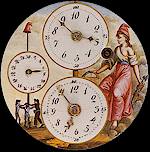
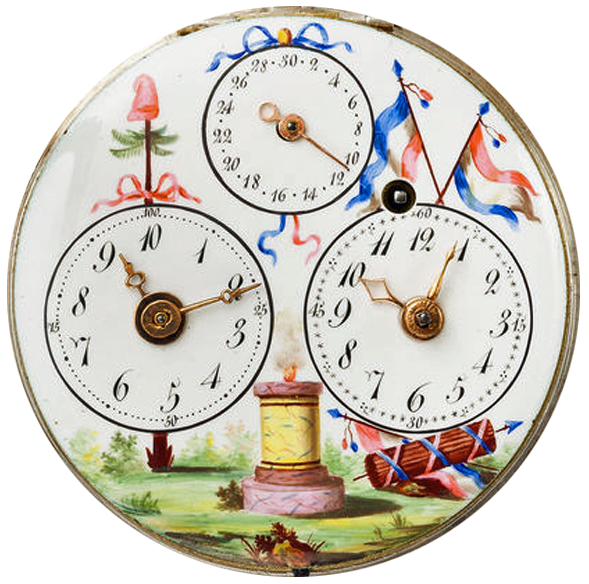
Revolution clock dials divided the day into 10 hours of 100 minutes, aligning timekeeping with the decimal system, and sometimes features both decimal and traditional 24-hour time displays.

The system was never really adopted and clockmakers had no real reason to fully support it, because their Revolution clocks were useless outside France which ruined their export trade.

TABLE OF CONTENTS


Index


Appendix.


Calendar & time.


Dials.


Republican <-> Gregorian conversion.


The Metric System


Names of the days of the Republican year.


The Republican calendar and decimal time


Symbols explained.


Sources & further reading.


    DIALS


Combined traditional & decimal dial
(click to enlarge)


Combined traditional & decimal dial with republican date.
(click to enlarge)
 
Combined traditional & decimal dial showing
republican days of the week and month.
(click to enlarge)
 

  SOME SYMBOLS EXPLAINED.


  The Phrygian cap,  Le bonnet Phrygien, Liberty cap.
   

The 1789 Revolutionaries adopted a cap worn by ancient Persian soldiers and the inhabitants of Phrygia, as they saw it as a symbol of liberation i.e. being freed and purified of evil. They wore a high woollen cap, normally falling over the right side of the head.
Its revolutionary significance stemmed from Roman custom, where newly emancipated slaves donned the cap to signify their transition to full citizenship.

Phrygian Cap

Helen and Paris the princeof Troy
The Troyan prince Paris
with Phrygian cap.
 
 The first Phrygian caps appeared on the heads of the French people a few months after the storming of the Bastille. They were made out of red woolen cloth and went with the striped clothes of the most fervent revolutionaries, the sans-culottes. Wearing the red cap was a way of publicly displaying one's patriotism.
Mouchet and Louis XVI  1792
1792 The people forcing Louis XVI to
wear the "Phrygian cap".


This cap was one of the star features of the historic day of 20th June 1792, when the common people surged into the Tuileries. In the angry crowd, which managed to reach the king himself, a municipal guard called Mouchet held out a Phrygian cap, on the end of a pike, to the monarch. The astounded descendant of Saint Louis did not know how to react. He grasped it and put it on his head. This gesture somewhat appeased the hostility of the assailants.

 Eye
Vigilance, essence and divine knowledge.


 Clasped hands  (l
es mains serrées).

(click to enlarge)

It appears on (Comtoise) clocks during the early 'royal' period of the republic and during the 'restoration'  (1814-1830) to express the (re)union of the people and their King. (symbole de l'union de trois ordres puis de peuple et de son Roi. Ref. René Schopping) 

It is also a symbol of fraternity, equality between citizens. Citizen to citizen, no hierarchy.


  The Triangle with plumb line
The perfect accord and balance.

  FASCES
  
 
A set of rods bound in the form of a bundle which contained an axe. The word fasces means "bundle" and refers to the fact that it is a bundle of rods, which surrounded an ax in the middle. In ancient Rome, the lictors carried fasces before consul, predators and dictators, i.e. magistrates that held imperium (which means that they had the right to command and interpret the flight of the birds).

Fasces surmounted by a Phrygian cap. Power to the liberated people.

Note: Fasces has also been the symbol of Italian fascists in the 20th century.
 

  Eagles 'Consulaire' and 'Imperial'


Eagle Consulaire
1799-1804  

 
I
mperial Eagle
1804-1814

An Imperial emblem.  In Greek mythology the Eagle was attributed to Zeus (Jupiter)


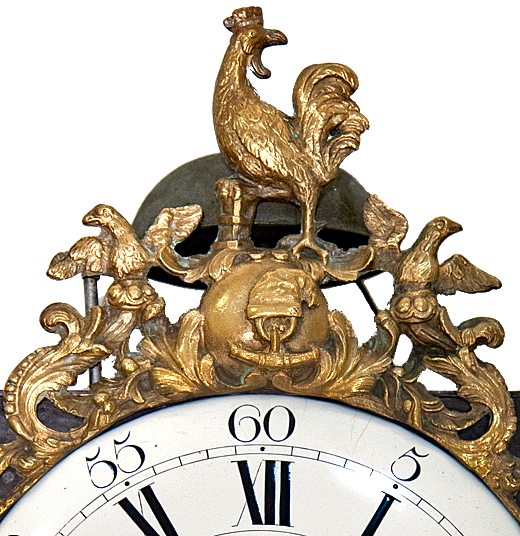
  Rooster (cockerel)

Vigilance.

Comtoise clock fronton with cockerel.
The three Royal fleurs-de-lis symbols
were scoured away during the Revolution.
(click picture for more)


One of the national emblems of France, the Coq Gaulois (the Gallic Rooster) decorated French flags during the Revolution. It is the symbol of the French people because of the play on words of the Latin gallus meaning Gaul and gallus meaning 'coq', or rooster.

 
Caesar called, what was later France, Gallia (Gaul), most likely because the rebellious Celts used a rooster as symbol in their escutcheon.

The rooster played an important role as the revolutionary symbol, but it would become an official emblem under the July Monarchy and the Second Republic when it was seen on the pole of regiments' flags. In 1830, the "Gallic Rooster" replaced the fleur-de-lis as the national emblem, and it was again discarded by Napoleon III.

The rooster is the emblem of (sponsored) French sports teams in international competitions.
 

  STAR

Star, pentagram.
(click to enlarge)
 
Restauration period  (1814-1824)
 

 La Carmagnole. 

A popular rather filthy song and dance against the imprisoned Royal Family.


(click for more)


Republican Airs selectable on
Dutch musical longcase clocks

(click to enlarge)

La Carmagnole (click here for lyrics and melody)


  TABLE OF SYMBOLS
 

Anchor - Hope
Bagpipe - Peace
Bastille - Emblem of the people conquering tyranny
Bishop's cross - Clergy
Broken chain- Abolishment of slavery
Canon - The power of the army
Carmagnole - Popular republican song and dance
Clasped hands - Fraternity
Corn (horn of plenty) - Nature's abundance
Corn sheaf - Abundance, Prosperity
Crown - Monarchy
Eye - Vigilance
Fame - Announcer
Fasces - Unity, Brotherhood, Power.  1)
Flag - The Nation
Fleur de Lys - Monarchy
France - The country (patriotic)
Globe - Universality
Guillotine - Revolutionary justice
Hive - The working class
Laurel (wreath) - Victory
Lion - Power
Oak - Civil virtue
Palm (branch) - Victory of the armies.
Phrygian cap - Symbol of liberty
Pique - The people
Rake - The third estate or commonalty
Rooster (cockerel) - Vigilance
Rosette tri-colour  - Emblem of the patriots
Rosette black  - Emblem of the Queen
Rosette white  - Emblem of the Royalists
Scale - Justice
Spade - The third estate or commonalty
Star - used during the restoration period
Sword - Nobility
Tree - Liberty
Triangle - The perfect accord
Two enlaced 'L's - Emblem of the Monarchy
Young woman with mirror - Truth


  THE METRIC SYSTEM


One of the main contributions of the French Revolution was the adoption of the metric system. An attempt to decimalize all aspects of daily life (calendar, measurements, currency, etc.)


The new decimal units, 4 November 1800. 
1. The litre, 2. the gram, 3. the metre, 4. the are (100 square metres),
5. the franc, and 6. the stère (1 cubic metre of wood).
 
Courtesy: Paris Musées.
 
As elsewhere in Europe, France’s old weights and measures originated from a system used by the Romans, which had evolved into a multitude of local variations. Enlightenment scholars were faced with the task of reforming a jumble of 800 different units of measurement, ranging from the toise to the lieue, including the quart and the pinte.

Some of these units were quite extravagant: in early 18th-century Bordeaux, a unit of land was defined by the distance a man’s voice could carry! It was better to have a loud voice if you wanted to be a landowner.

There was little to no standardization: in Paris, for example, a pinte equaled 0.93 liters, while in Saint-Denis it was 1.46 liters. An aune, used to measure fabric, was based on the width of local looms and varied greatly. This chaotic system was prone to fraud and stifled both domestic and international trade.

Courtesy: Jaz le Bon Temps

  The Republican Calendar and Decimal time
 

1793   Decimal or Revolutionary time was adopted by decree of the National Convention in 1793. (more on the adoption) It stipulated that the Gregorian calendar should be abandoned and replaced by the Republican calendar which divided the day into ten hours each with one hundred minutes and then further sub-divided into one hundred seconds.
Although perhaps a logical 'simplification' of timekeeping the habits of the populous were difficult to change. The new system meant having to design a new dial and to this end a competition was organized to invent one that was clear and easy to read.

1795   Despite the efforts of some of the great horological minds the system was never really adopted and clockmakers had no real reason to fully support it because their Revolution clocks were useless outside France which ruined their export trade.

By art. 22, April 7, 1795 it was no longer compulsory to use Decimal time and even before then clocks and watches were being made with both the 'old' and 'new' systems as on the example below.

1806   Finally it was decreed that the Decimal system had proved impossible to implement properly and from January 1, 1806 French timekeeping reverted back to the traditional system.


(click to enlarge)


  CALENDAR & TIME


The republican year commences the 22nd of september and ends the 21st of september.

The years were numbered as follows:

Year

II
III
IV
V
VI
VII
VIII
IX
X
XI
XII
XIII
XIV
XV

Starts 22 sept:

1793 
1794 
1795 
1796 
1797 
1798 
1799 
1800 
1801 
1802 
1803 
1804 
1805 
1806

The year is divided in 12 equal months of 30 days each, plus 5 or 6 days called 'sans-culottides'
(the days of the poor) which were renamed, after august 24 1794, 'complementary days'. (jours complémentaires)  
They were treated as Holidays, or Festival days and were named:

1
2
3
4
5
6

Jour de la Vertu (Virtue),
Jour de Genie (Genius),
Jour de Travail (Work),
Jour de la Raison (Reason),
Jour de la Recompense (Reward)
Jour de la Revolution (Revolution).


The names of the months are:

Autum:


Winter:


Spring:


Summer:

Vendémiaire
Brumaire
Frimaire 
Nivôse
Pluviôse
Ventôse 
Germinal
Floréal
Prairial
Messidor
Thermidor
Fructidor
Vintage
Fog
Frost
Snow
Rain
Wind
Germ
Flowers
Meadow
Harvest
Heat
Fruit

Each month was divided in three equal parts of 10 days named:

 
first
second
third
decade
decade
decade

The names of the days of the decades were:

  Primidi
Duodi
Tridi
Quartidi
Quintidi
Sextidi
Septidi
Octidi
Nonidi
Décadi
 

Each day was divided in: 

                 10 hours of 100 minutes of 100 seconds each.

A
multiple of ten decimal minutes was often called a 'décime', i.e. one-tenth of a decimal hour. It was also conveniently close to a traditional quarter-hour.


  INDEX     Type 'Ctrl + F' to find any word or number on this page.


a

b
Bonnet Phrygien

c
Calendar & Time

Carmagnole

Clasped hands

d

Decades & days

Dials

e

Eagles

Eye

f

Fasces

g

Gregorian calendar

h
Hours & minutes


l
Liberty cap

m
Metric

Months

p

Phrygian cap

r

Rooster

s

Star

Symbols table

Symbols, table French

Sources

t

Triangle

y

Years


     Sources and further reading:
 
1) Les Heures Revolutionnaires.
Yves Droz et Joseph Flores
Edité par l'
Afaha.
 
 
2) Cadrans de la Révolution, 1789-1800
Watch dials of the French Revolution,
Zifferblätter der französischen Revolution,
Roberto Panicali.
Publisher: Scriptar Lausanne 1972
ISBN: B0000E810O

3)
Decimal time history.
by: John D. Hynes.

4)
More on the ADOPTION of the new calendar.
 
As to the New Calendar, we may say here rather than elsewhere that speculative men have long been struck with the inequalities and incongruities of the Old Calendar; that a New one has long been as good as determined on. Marechal the Atheist, almost ten years ago, proposed a New Calendar, free at least from superstition: this the Paris Municipality would now adopt, in defect of a better; at all events, let us have either this of Marechal`s or a better,--the New Era being come. Petitions, more than once, have been sent to that effect; and indeed, for a year past, all Public Bodies, Journalists, and Patriots in general, have dated First Year of the Republic. It is a subject not without difficulties. But the Convention has taken it up; and Romme, as we say, has been meditating it; not Marechal`s New Calendar, but a better New one of Romme`s and our own. Romme, aided by a Monge, a Lagrange and others, furnishes mathematics; Fabre d`Eglantine furnishes poetic nomenclature: and so, on the 5th of October 1793, after trouble enough, they bring forth this New Republican Calendar of theirs, in a complete state; and by Law, get it put in action.

(back to context)

Source: T
he French Revolution A History.
By Thomas Carlyle.

This article is subject to ongoing updates.